
What Is Personality Type?
Based on his observations, Jung concluded that differences in attitudes and behaviors result from the natural tendencies people have to use their minds in different ways. As people act on their natural tendencies, they develop corresponding patterns of behavior that they find satisfying and fulfilling. Jung’s personality type theory defines eight different patterns of behavior, which he called types, and he provided a detailed description of how they develop.
- Jung’s Picture of Personality
- Why the Differences Between People?
- Myers and Briggs’ Expansion & Refinement of Jung’s Theory
- The Dynamic Energy of Myers-Briggs Type
Jung’s Picture of Personality
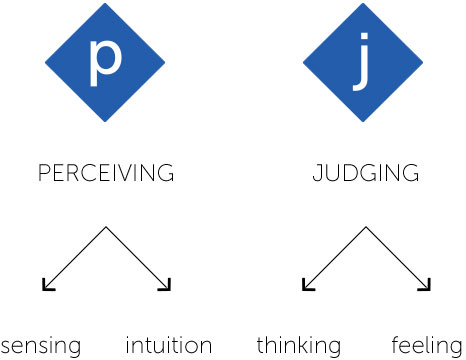
Jung observed that when people’s minds are active, they are engaged in one of two opposite and basic mental processes:
- Perceiving—taking in or gathering information
- Judging—coming to conclusions and making decisions about what they have perceived
The two opposite ways of taking in information are called Sensing and Intuition. The opposite ways of coming to conclusions and making decisions are called Thinking and Feeling.
Basic Mental Processes
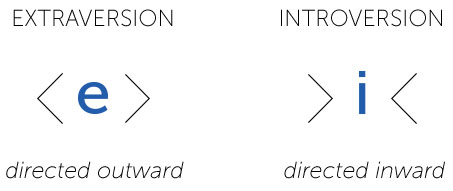
Jung also saw that people tend to focus their attention and be energized more by interacting with the external world of people, things, and activities, or more by reflecting on the internal world of ideas, thoughts, and observations. He called these two orientations of energy Extraversion and Introversion.
Orientations of Energy
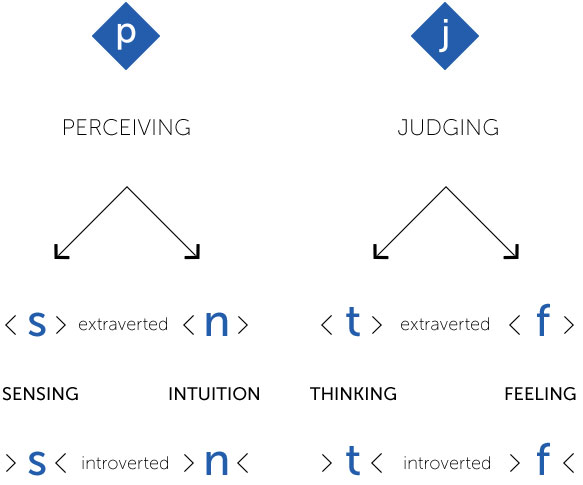
While each of the four mental processes—Sensing, Intuition, Thinking, and Feeling—has its own predictable characteristics, each also takes on a different character depending on whether the process is focused more on the outer Extraverted world or on the inner Introverted world.
Jung’s Eight Patterns of Mental Activity
Why the Differences Between People?
While all eight patterns of mental activity are used by everyone at least some of the time, Jung believed that people are innately different in which one of the eight they prefer over all the rest. This innate preference leads individuals to use their preferred pattern as often as possible, seek out situations where they can use it, and develop habits of behavior and personality attributes that result from using it. Jung called this favorite pattern or process their dominant function or primary process.
Differences among people in the mental process that is dominant—most preferred, used, and developed—lead to fundamental differences between people. The resulting predictable patterns of behaviors, in dynamic interaction with the other, less preferred mental processes, form personality types.
In addition to the dominant function, Jung identified a second favorite, or auxiliary, process and a least favored process, the inferior function. Jung wrote extensively about the eight dominant functions and their corresponding eight inferior functions but gave little attention to the second and third processes and their role in an individual’s type.
Myers and Briggs’ Expansion and Refinement of Jung’s Theory
Jung acknowledged that his type system was incomplete. However, his writings contained some intriguing suggestions about his intentions for the missing parts of his theory. From their careful reading of Jung’s work, Myers and Briggs were able to expand Jung’s original system in two ways:
- By determining the orientation of energy (Extraversion or Introversion) that characterized the second favorite, or auxiliary, process
- By adding a fourth pair of opposites, the Judging–Perceiving orientation
These innovations led to the identification of the 16 types that are described in the MBTI assessment. The term Jung-Myers theory of personality types is used to differentiate between Jung’s original theory and the Myers-Briggs Type Indicator approach to personality type.
The 16 MBTI® Personality Types
The Dynamic Energy of Myers-Briggs® Type
The 16 Myers-Briggs types do not define personality as 16 static boxes. Rather, they describe a dynamic energy system of interacting personality preferences that are expressed as pairs of opposites. Everyone tends to prefer one of each pair of opposites over the other.
Your Myers-Briggs personality type represents your natural preferences in the four aspects of personality described, which account for the natural differences between people. There is no right or wrong to these preferences. Each identifies normal and valuable human behaviors.
The Four Myers-Briggs®
Preference Pairs
Each preference is a multifaceted aspect of personality complete with its own set of attributes. Although we first begin to understand personality by focusing on the preferences, it is the combination of the preferences that make up our four-letter Myers-Briggs type that provides the fullest and richest picture of our personality.
Note:
While the names of some of the MBTI preferences are familiar words, their MBTI meaning is somewhat different from their everyday meaning. Remember:
Extraversion does not mean talkative or loud. Introversion does not mean shy or inhibited. Feeling does not mean emotional. Judging does not mean judgmental. Perceiving does not mean perceptive.